How Far Should a Wood Stove Be from a Wall?
On this page (8 sections)
- Understanding Wood Stove Clearance Requirements
- Finding Your Stove’s Specific Clearance Requirements
- Understanding Different Types of Clearances
- Reducing Clearances with Wall Protection
- The Importance of Local Codes and Professional Installation
- Your Wood Stove Installation Checklist
- Conclusion
- Frequently Asked Questions
To determine how far a wood stove should be from a wall, you must consult its UL (Underwriters Laboratories) safety label or owner’s manual; this document specifies the minimum clearance distances required for safe operation. These distances are not arbitrary; they are critical for preventing heat transfer to combustible materials and ensuring your home’s safety.
Ignoring these clearance requirements can create a serious fire hazard. Each wood stove model has unique specifications based on its design, insulation, and heat output, so always check your specific stove’s documentation. Don’t guess; your safety depends on getting this right!
TL;DR:
- Always check your wood stove’s UL label or owner’s manual.
- It lists the minimum safe distances to walls and other combustibles.
- Clearances vary by stove model due to design and heat output.
- Improper clearance is a major fire risk.
Let’s walk through everything you need to know about wood stove clearances, from understanding the official requirements to finding certified heat shields and ensuring a safe installation.
Understanding Wood Stove Clearance Requirements
You’re wondering about the distance your wood stove needs from walls, right? It’s a common question, and getting it right is vital for safety. The short answer is: it depends entirely on your wood stove wall clearance safety.
Every wood stove manufactured in the United States must meet certain safety standards. These standards are set by organizations like Underwriters Laboratories (UL) or Intertek (ETL). When a stove passes these tests, it gets a special label, often called a UL label or certification label. This label is your go-to source for clearance information.
Think of this label as your stove’s ID card for safety. It tells you exactly how much space — or “clearance” — you need between your stove and any combustible materials. Combustible materials are anything that can catch fire, like wood walls, drywall, furniture, curtains, or even that stack of old magazines (National Fire Protection Association). Even if a material looks fire-resistant, it might still be considered combustible by safety codes.
Why Clearances Matter So Much
You might think, “It’s just a little heat, what’s the big deal?” But heat from a wood stove isn’t just radiant heat that you feel directly. There’s also convective heat, which is air warmed by the stove circulating through your room. Over time, even lower temperatures can cause combustible materials to degrade. This process is called pyrolysis.
Pyrolysis makes wood and other materials more susceptible to ignition at lower temperatures. What was once safe can become a fire hazard after years of exposure to heat. This is why guessing or estimating clearances is so dangerous. Manufacturer-specified clearances prevent this silent danger.
The Science Behind Safe Distances
Stove manufacturers conduct rigorous testing to determine safe clearances. They use thermocouples to measure temperatures on nearby surfaces under various operating conditions. If the temperature on a combustible surface exceeds a certain limit (typically 117°F above ambient temperature for wood), the clearance is deemed unsafe. They adjust the distances until the temperatures remain below the critical threshold. This scientific approach ensures your safety.
So, those distances aren’t just arbitrary numbers. They are the result of careful engineering and safety testing. Respecting these numbers is non-negotiable for home fire safety.
Finding Your Stove’s Specific Clearance Requirements
The first and most important step is to locate the official documentation for your wood stove. This information will prevent headaches and ensure safety. Do you know where your stove’s manual is? If not, let’s find it!
Checking the UL Label or Owner’s Manual
The UL label is usually a metal plate or sticker attached to the back or side of your wood stove. It lists important information, including the model number, serial number, and, most importantly, the minimum clearances to combustible materials for the sides, rear, and top. It will often specify clearances for both “unprotected combustible walls” and “walls protected with a listed wall protector.”
If you can’t find the label, or it’s unreadable, your next best bet is the owner’s manual. Most manufacturers provide these manuals as PDFs on their websites. A quick search for “your stove brand your stove model owner’s manual” should do the trick. The manual will contain detailed installation instructions, including diagrams illustrating required clearances.
What if You Can’t Find the Information?
If your stove is very old or you’ve inherited it without documentation, finding specific clearances can be tough. In this situation, it’s wise to contact the manufacturer directly with your stove’s model and serial number. They might be able to provide the original manual or clearance specs. If all else fails, you may need to apply the National Fire Protection Association (NFPA) 211 standards for unlisted appliances. These standards are much more conservative, often requiring 36 inches of clearance to all combustible walls (NFPA 211). This is a significantly larger distance than most listed stoves, but it’s the safest default if you have no other information.
Understanding Different Types of Clearances
When you look at your stove’s manual, you’ll see different types of clearances listed. It’s not just one number for everything. Let’s break down what each means.
Rear, Side, and Corner Clearances
You’ll typically see clearances specified for:
- Rear Clearance: The minimum distance from the back of the stove to the wall behind it.
- Side Clearance: The minimum distance from the sides of the stove to any adjacent walls.
- Corner Clearance: If you’re installing your stove in a corner, this is often a specific, sometimes smaller, clearance to two walls forming a 90-degree angle. This is because the walls themselves can act as a partial heat shield.
These distances are crucial because heat radiates in all directions. The design of your stove, including its insulation and internal baffling, dictates how much heat radiates from each surface. Always measure from the stove’s outer jacket, not from any decorative features that extend beyond the main body.
Top Clearance and Flue Pipe Clearances
Don’t forget about the space above your stove! The top clearance is the minimum distance from the top of your stove to the ceiling or any overhead combustible materials. This is important to prevent heat from building up and igniting combustibles above. Also, pay close attention to the clearance for your flue pipe (chimney connector). This pipe gets very hot and usually requires a larger clearance than the stove itself, often 18 inches to combustible materials, unless you use a listed double-wall pipe with reduced clearance ratings.
Reducing Clearances with Wall Protection
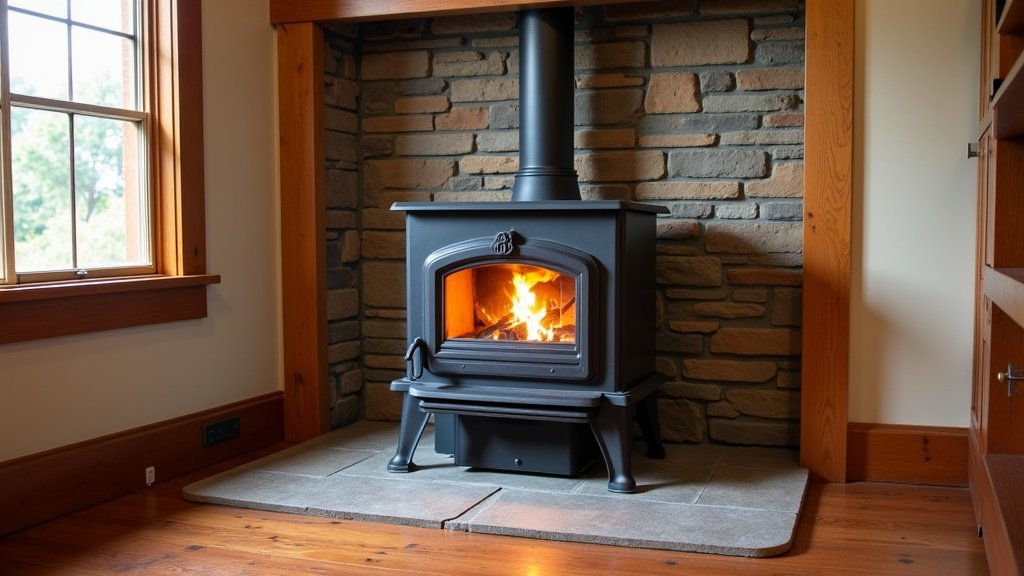
What if your ideal stove placement just doesn’t meet the standard clearances? Don’t despair! You can often reduce the required distances by installing approved wall protection, also known as a heat shield.
Approved Wall Protection Materials
Heat shields work by creating an air gap between the hot stove and the combustible wall, reflecting heat, or absorbing it. Not just any material will do. Approved wall protection must be:
- Non-combustible: Materials like cement board, brick, stone, or sheet metal.
- Properly spaced: There must be at least a 1-inch air gap between the protector and the combustible wall. This air gap is critical for convection cooling. Without it, the heat shield acts more like a heat sink and can transfer heat directly to the wall.
- Ventilated: The air gap should allow air to flow, typically with openings at the top and bottom to promote air circulation.
The amount of clearance reduction you get depends on the material, thickness, and how it’s installed. Your stove manual or local building codes will provide specific reduction percentages. For example, a single layer of 24-gauge sheet metal spaced 1 inch from the wall might offer a 33% reduction, while brick veneer with a 1-inch air gap might offer a 50% reduction (NFPA 211). Always check the exact specifications.
DIY vs. Certified Wall Protection
While you can sometimes build your own wall protection according to NFPA 211 guidelines, it’s often simpler and safer to purchase listed or certified wall protection systems. These are tested assemblies that come with their own clearance reduction ratings. They typically consist of decorative panels with integrated air-gap spacers. This takes the guesswork out of compliance and often looks nicer too!
The Importance of Local Codes and Professional Installation
Beyond manufacturer specifications, you must also consider local building codes. These codes can sometimes be stricter than the manufacturer’s recommendations. For example, your county might require specific hearth pad dimensions or mandate certain types of chimney systems.
Consulting Your Local Authority Having Jurisdiction (AHJ)
Before you even buy a stove, it’s a good idea to contact your local building department or fire marshal’s office. They are your “Authority Having Jurisdiction” (AHJ). They can provide information on local permits, inspection requirements, and any specific code amendments for wood-burning appliances in your area. Ignoring local codes can lead to fines, difficulties with insurance, and, most importantly, safety hazards.
Many homeowners skip this step, but it’s a critical part of ensuring a safe and compliant installation. Would you want to find out after installation that your setup isn’t up to code?
The Value of Professional Installation
While some homeowners are handy, installing a wood stove is not a typical DIY project. A certified professional installer (often certified by the National Fireplace Institute – NFI) knows the manufacturer’s requirements, local codes, and best practices. They can:
- Correctly size your stove for your space.
- Ensure proper chimney system design and installation.
- Accurately measure and install clearances and heat shields.
- Perform a crucial safety check before the first fire.
The cost of professional installation is an investment in your safety and peace of mind. It can also be a requirement for many homeowner’s insurance policies (Insurance Information Institute). Don’t cut corners when it comes to fire safety.
Your Wood Stove Installation Checklist
To summarize, here’s a quick checklist to help you ensure your wood stove is installed safely and correctly. Use this as a guide before and during your installation process.
- Locate and review your stove’s UL label and owner’s manual for specific clearances.
- Identify all combustible materials near your proposed stove location.
- Measure and mark the required rear, side, corner, and top clearances.
- Determine if you need a heat shield to reduce clearances, and ensure it’s properly listed/installed.
- Contact your local building department for permits and to understand local codes.
- Consider hiring an NFI-certified professional for installation and final inspection.
Following these steps will help you enjoy the warmth of your wood stove safely for years to come. Your home and family deserve that level of care.
Conclusion
You now understand that safe wood stove installation hinges on one primary rule: always follow manufacturer specifications. Those clearance distances are scientifically determined to prevent fires from radiant and convective heat, and the long-term effects of pyrolysis. Don’t guess; your home and family’s safety depend on precise measurements and adherence to certified guidelines. Whether you’re installing a new stove or re-evaluating an old one, taking the time to confirm clearances, consider heat shields, and consult local codes is paramount. When in doubt, a certified professional can ensure everything is up to snuff.
Your next step should be to locate your stove’s manual and UL label to verify its specific clearance requirements.
Frequently Asked Questions
Can I install a wood stove closer to a wall if I only burn it occasionally?
No, the frequency of burning does not change the required minimum clearances. The safety distances are based on the potential maximum heat output and the long-term effects of heat exposure on combustible materials, like pyrolysis. Always adhere to the manufacturer’s specified clearances, regardless of how often you plan to use your stove.
What if my wood stove doesn’t have a UL label or manual?
If you cannot find a UL label or owner’s manual, or if the stove is unlisted, you must apply the most conservative clearance standards. This often means a minimum of 36 inches to all combustible surfaces, as outlined by NFPA 211. It’s highly recommended to consult a certified professional in such cases, as guessing can be extremely dangerous.
Does a stone or brick wall count as a non-combustible material?
While stone and brick themselves are non-combustible, the wall structure behind them, like wood studs, often is. Therefore, simply having a stone or brick veneer on a combustible wall does not automatically eliminate clearance requirements. You usually need an air gap between the non-combustible facing and the combustible wall to truly reduce clearances effectively, creating what’s known as a “listed wall protector.”
Can a ceiling fan help reduce top clearances?
A ceiling fan can help circulate warm air throughout a room, improving heating efficiency. However, it does not reduce the minimum top clearance required for a wood stove. The top clearance is set to prevent overheating of overhead combustible materials, and air movement from a fan doesn’t sufficiently address the radiant heat directly above the stove.
What kind of professional should I hire to install my wood stove?
For safe and compliant wood stove installation, you should hire a professional certified by the National Fireplace Institute (NFI). NFI-certified technicians have specialized training in solid fuel appliance installation, chimney systems, and safety codes. They can ensure your stove meets all manufacturer and local requirements.